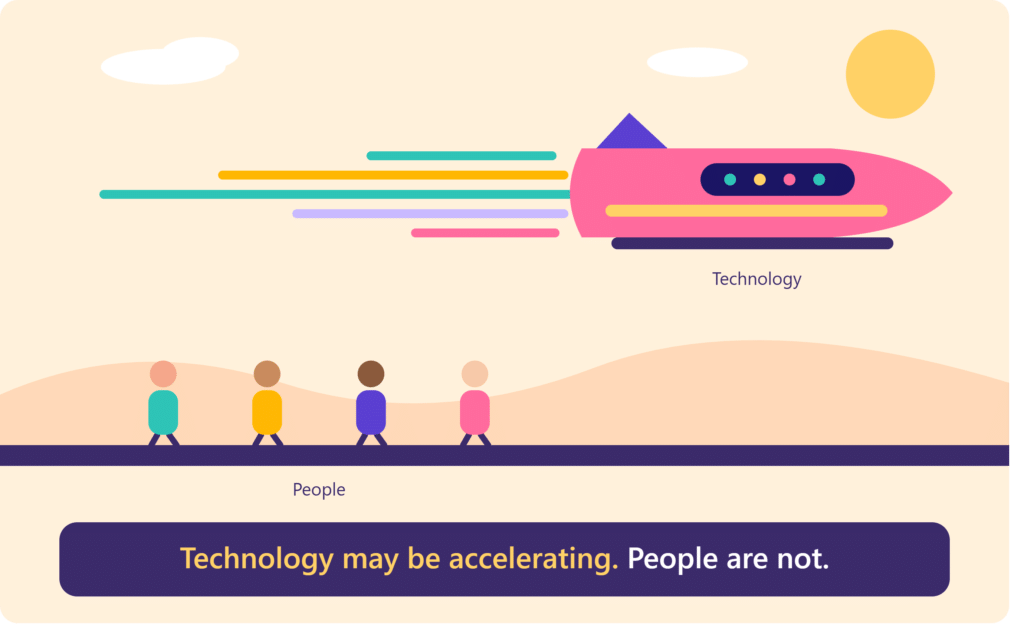
 The smartest part of the AI bet is not the technology. It is how well the cost is hidden.
|
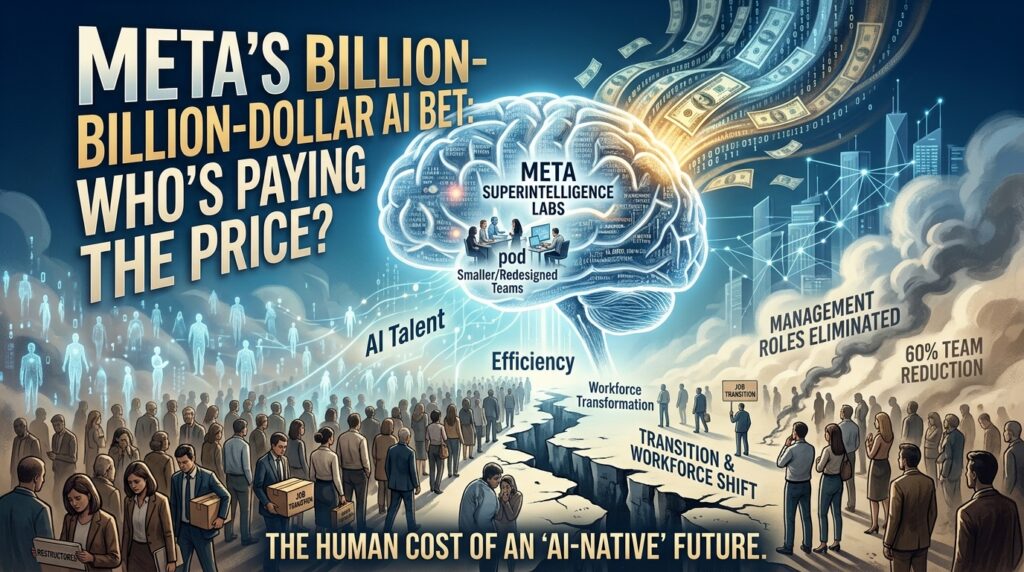
Meta wants to build the future with artificial intelligence, but somewhere along the way, the company discovered an uncomfortable question: what happens to the people building that future? There is a strange contradiction unfolding inside Meta. The company is spending extraordinary amounts of money to make artificial intelligence more powerful. It is recruiting some of the world’s most sought-after AI researchers, building enormous computing infrastructure, and reshaping teams around AI. At the same time, thousands of employees have been pushed out, moved into new roles, or asked to adapt to a workplace increasingly designed around machines, and that makes Meta’s AI story about much more than technology. It is becoming a story about people, power and the future of work. The Billion-Dollar BetMeta’s ambition is anything but modest. Mark Zuckerberg has been aggressively positioning the company for the next phase of the AI race, including the creation of Meta Superintelligence Labs and an extraordinary push to recruit elite AI talent. In 2025, Meta reportedly made offers worth hundreds of millions of dollars over several years to attract top researchers.
Then came the infrastructure bill. Meta said its 2026 capital spending could reach $125 billion to $145 billion, driven largely by its AI ambitions. That is a staggering amount of money, and when a company makes an investment of that scale, something has to change. At Meta, that change has increasingly reached the workforce. When AI Meets the Org ChartIn May 2026, Meta announced plans to cut around 10% of its workforce, while also moving about 7,000 employees into new initiatives related to AI workflows and eliminating management roles. The message was clear: Meta was not simply trying to become an AI company. It wanted to become an AI-native company. That distinction matters. An AI company builds AI products. An AI-native company tries to organize the entire business around AI. That means asking uncomfortable questions: Can one employee accomplish what previously required a team? Can AI tools eliminate layers of management? Can smaller teams move faster? Can software agents perform work that once required people? Meta began exploring precisely those questions. One internal transformation effort, known as Project OT, envisioned smaller teams or “pods” with fewer employees and less management, supported heavily by AI tools. Reuters later reported that some teams could have faced reductions of as much as 60% under the plan. On paper, it sounded incredibly efficient. In practice, things became much messier. The Problem With the Perfect AI WorkforceThere was a catch. AI did not always work as perfectly as the spreadsheets suggested. Employees reportedly encountered reliability and security problems with AI agents and coding tools. Productivity gains also fell short of expectations in some areas, and employees pushed back. Meta’s CTO Andrew Bosworth later acknowledged that the rollout of the company’s new AI division had been poorly handled, promising better communication and greater stability for employees. Zuckerberg himself acknowledged that Meta had made mistakes during its AI workforce transformation. In an internal memo, he said the company had made, and would likely continue to make mistakes as it navigated the rapidly changing technology landscape.
The Irony: AI Is Creating Jobs While Removing OthersHere is where the Meta story gets particularly interesting. Meta is not simply firing people because it has AI. It is also hiring aggressively because of AI. The company has recruited elite researchers and engineers while restructuring other parts of its workforce. Its AI ambitions have created demand for highly specialized talent even as other roles become candidates for automation or consolidation. So the workplace is not necessarily becoming jobless. It is becoming different.
There Is Another Problem: Humans
Employees still need stability. They need to understand where their careers are heading. They need time to learn new systems. They need managers who can communicate what is happening, and perhaps most importantly, they need to believe that the technology being introduced is actually helping them, not simply being used as a reason to reduce headcount. Meta’s experience suggests that the human side of an AI transformation can be just as difficult as the technical side. Reuters reported that Meta ultimately scaled back Project OT after employee backlash, concerns about productivity, communication problems and issues with AI tools. That is a fascinating twist. The company trying to build a more efficient AI-powered workforce discovered that people themselves could become the biggest variable in the equation. The Bigger QuestionMeta’s experiment matters far beyond Meta. Amazon, Microsoft, PayPal, Dell, Visa and other major companies have also been reducing headcount while increasing investment in AI and automation. Reuters reported that more than 100,000 job cuts had been linked to AI-related changes in 2026, but the future probably will not be as simple as: AI replaces humans. A more realistic scenario is:
The difficult part is the transition, and transitions can be painful. The Real Meta ExperimentMeta’s biggest AI experiment may not actually be about building superintelligence. It may be about answering a much more ordinary question:
That question does not have an easy answer. Meta is still investing heavily in AI. It still believes the technology will fundamentally reshape its products and operations, and Zuckerberg clearly has no intention of abandoning the AI race, but the company’s recent experience offers a valuable warning: AI can make a company faster, AI can make a company leaner, AI can make a company more powerful, but none of that guarantees that AI will make a company better, because companies are not built from algorithms alone. They are built from people, and as Meta races toward an AI-powered future, the most important question may not be how intelligent its machines become. It may be how intelligently it treats the humans working alongside them.
|