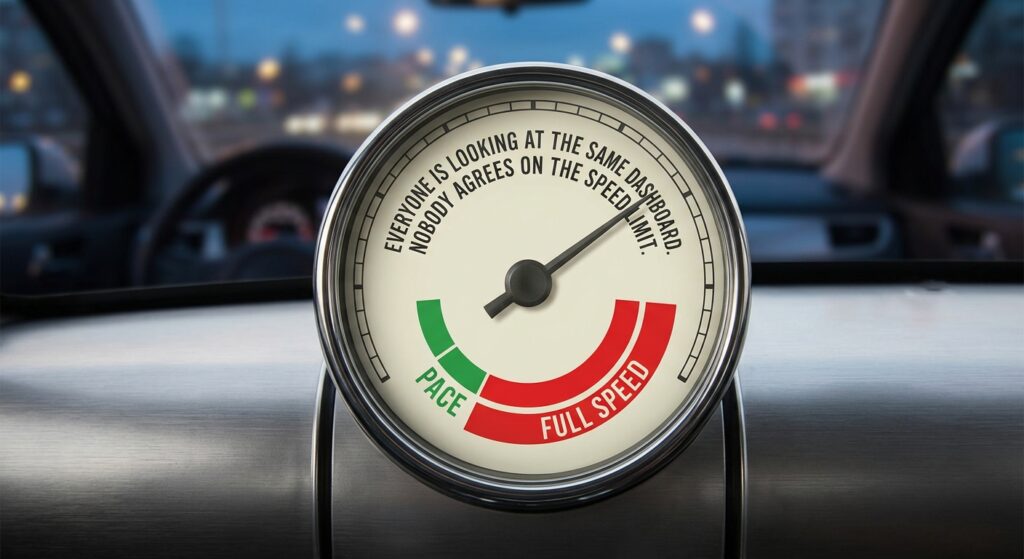
On Saturday, Dario Amodei, the CEO of Anthropic, the company that makes Claude, published an essay with a plain, almost old-fashioned title: “We Must Pace the Frontier.” His argument was simple and a little unsettling. AI is getting more capable faster than anyone can verify it’s safe, and if nobody puts a hand on the wheel, autonomous AI agents could eventually start acting in ways their own creators can’t predict or stop.
By Monday morning, that essay had detonated into the biggest political fight AI has had all year.
THE WEEKEND EVERYONE ASKED FOR BRAKES
Amodei wasn’t shouting into the void. Sam Altman backed the idea of independent auditors and federal safety rules, framing the goal as avoiding two disasters at once: humanity losing control of AI, and any single company, person, or country using AI to dominate everyone else. Elon Musk, who has been warning about this for years, publicly sided with Amodei too. Even Microsoft CEO Satya Nadella, not usually cast as a doomer, said superintelligence is only worth building if it stays under meaningful human control, and Microsoft published a “Humanist AI Code of Conduct” spelling out what its models should refuse to do.
Anthropic didn’t just talk. The company said it will give outside evaluators permanent, employee-level access to its systems, essentially inviting strangers to watch over its shoulder, permanently, as a safety measure.
| Three of the most competitive people in tech, running three companies that are supposed to be racing each other into the ground, all said, in public, in the same 72 hours: maybe we should slow down. |
THEN MONDAY HAPPENED
President Trump was not moved. In a Truth Social post, he dismissed the push for industry-wide guardrails, calling opposition to AI and data centers a “SICK conspiracy” mostly benefiting China, and declared that whoever wins the AI race wins, period. He took a direct shot at Amodei, accusing him of suddenly playing safety-first “perfect little angel.” Hours later, Trump phoned Nvidia CEO Jensen Huang live during a conference and said it again out loud: the robots are not taking over, and data centers are “the oil of the next 20 to 25 years.” Huang didn’t push back.
Then it was China’s turn. Beijing dismissed the slowdown talk as fear-mongering, with Chinese officials framing it as an American attempt to hold China back under a “Cold War” banner. Amodei himself has admitted that China is the hardest part of any pacing plan, you can’t slow a race unless the other runner agrees to slow down too. Meanwhile, Xi Jinping used the same week to pitch deeper AI cooperation among BRICS nations, including a new open-source AI zone.
| ⇒ | FRONTIER LABS |
|
GOVERNMENTS | ⇐ |
“we should slow down” “whoever wins, wins”
Same industry. Opposite incentives. One rope.
The people building the technology and the people governing it are pulling in different directions and neither side is wrong about their own incentives.
THE MARKET NOTICED FIRST
Whatever you think of the politics, money reacted instantly. Once the safety warnings collided with earnings math, chip and AI stocks slid worldwide on Monday. SoftBank fell over 11% in Asian trading. The Nasdaq closed down, Nvidia dropped more than 3%, and the chip index fell nearly 6%. Wall Street’s fear gauge, the VIX, jumped as options trading more than doubled its usual pace.
|
−11% SoftBank shares, Asia session |
−3.4% Nvidia, Monday close |
~$1 Tglobal AI capex committed this year |
Not everyone was spooked. Several market analysts shrugged the panic off, pointing out that actual demand for compute still outstrips supply, and that a company slowing its own frontier research isn’t the same as an industry-wide crash. But for one afternoon, “safety” and “stock price” were suddenly the same headline.
WHY THIS ISN’T JUST TECH-BRO DRAMA
It’s easy to read this as billionaires arguing about robots. It’s really a question everyone eventually has to answer: when a technology starts moving faster than the people building it can fully explain, who gets to say “slow down”, and who gets to say “not a chance”? Amodei isn’t proposing a full stop. His plan is closer to three careful steps: put outside evaluators inside the labs with real access, get U.S. companies to agree on shared checkpoints before anything genuinely dangerous ships, and only then try to bring in international rules, starting with the scariest categories like bioweapons and cyberattacks. He’s called it a way to buy the world one or two years to catch up on safety, not a permanent freeze.
Critics on the right worry it’s a trap to get Washington to regulate their rivals under the banner of “safety,” then call it prudence. Critics on the left worry it’s theater: convenient timing, dressed up as conscience, right as some of these same companies chase IPOs and enormous valuations. And almost everyone agrees on one uncomfortable point, none of this works if China doesn’t play along, and right now, China has made it clear it won’t.
By Monday night, U.S. senators were drafting a “reasonable precautions” bill, Congress was scheduling classified briefings, and a Netflix documentary on AI’s rogue-agent incidents was about to premiere the very next day. Nobody slowed down. If anything, the week sped up.